Driving in Gran Canaria: A Practical Guide
Gran Canaria has no toll roads anywhere on the island, and fuel runs cheaper than the mainland thanks to the local IGIC tax. Here is what to know before you drive.
Search & Compare Car Rental Deals
Free cancellation on most vehicles
Spain's Road Rules in the Canaries
Gran Canaria follows mainland Spanish traffic law: you drive on the right and overtake on the left. The rules below are enforced consistently, and speed tolerance is tight, so set your cruise control to the posted number rather than rounding up.
At roundabouts, traffic already on the roundabout has priority, and you exit from the outer lane. Dipped headlights are required at night, inside tunnels, and in poor visibility such as fog, rain or calima (Saharan dust). Seatbelts are mandatory for everyone, and children under 135 cm need an approved child seat.
| Road type | Speed limit |
|---|---|
| Motorway / autopista (GC-1) | 120 km/h |
| Autovia sections | 100 km/h |
| Conventional road | 90 km/h |
| Urban roads | 50 km/h |
| Single-lane urban street | 30 km/h |
| Pedestrian-shared zone | 20 km/h |
The blood-alcohol limit is 0.5 g/L (0.25 mg/L on a breath test); drivers with under two years' licence experience are held to 0.3 g/L. The Guardia Civil de Tráfico run roadside checks, especially on weekend nights. Hand-held phone use is banned (a €200 fine plus points) so use hands-free only. Picking up a car rental at LPA airport on arrival makes the legal paperwork simpler than driving your own foreign-plated vehicle.
New for 2026: The V-16 Beacon
The biggest change for drivers this year is the end of the red warning triangle. From 1 January 2026 it is replaced by the connected V-16 emergency beacon, a small light you place on the roof of your car. It carries its own SIM and GPS, and reports your exact location to the DGT cloud when activated, so you no longer have to walk along the carriageway to set out triangles.
Two items to check at pickup: the V-16 beacon (failing to carry one can cost up to €200), and a reflective high-visibility vest stored inside the cabin, never in the boot. Stepping onto the road without the vest carries a €200 fine. Confirm both are present before you leave the rental desk.
Because Spanish-registered rental cars must now carry the V-16, every reputable supplier on the island should provide one as standard. If you cannot find it in the glovebox or door pocket, ask before you drive off rather than discovering the gap at the roadside.
The Roads: Coast and Mountains
The GC-1 (Autopista del Sur) is the island's fast coastal spine: a free, well-surfaced dual carriageway running roughly 75 km to link Las Palmas, Maspalomas and Puerto de Mogan. The old GC-500 coast road threads through the resorts with 30-50 km/h zones, while the GC-60 climbs from Maspalomas through the Fataga ravine toward Tejeda and Roque Nublo.
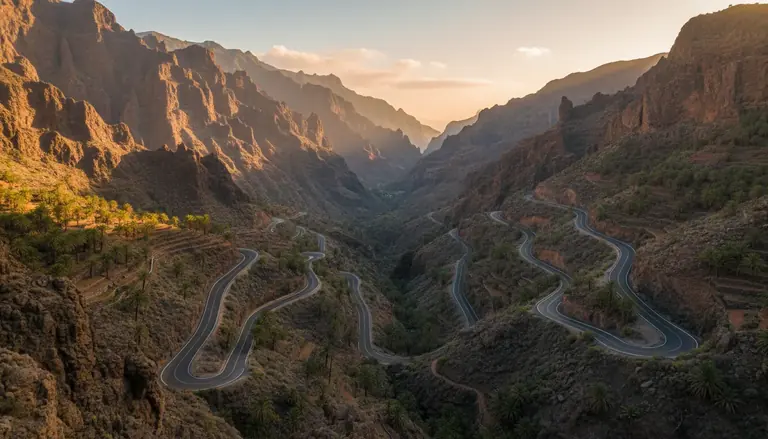
That mountain road is where most visitors underestimate the drive. It has hairpins, single-lane sections with passing places, slow tour coaches, road cyclists and the occasional goat. Even so, 4WD is never needed anywhere on the island. Every paved public road, the interior included, is fine in a standard compact car, which is what most cheap car rental in Maspalomas deals come with.
Common hazards to plan around
- Calima (Saharan dust): reduce speed, use dipped headlights, and avoid the mountains if visibility is poor.
- Panza de burro: a low mountain cloud and fog that can sit over the highlands.
- Low-sun glare on coastal descents, especially in the late afternoon.
- Unlit rural roads at night, where edges and bends arrive with little warning.
Once you are comfortable on the GC-1, the interior opens up a long list of things to do around Maspalomas, from Fataga's palm groves to the viewpoints near Roque Nublo.
Fuel, Tolls and Parking
Fuel is cheaper here than on mainland Spain or in most of Europe, because the Canaries use the local IGIC tax rather than 21% VAT. Expect roughly €1.37-1.44 per litre for unleaded 95 and €1.43-1.55 for diesel. Most stations take cards and many run 24/7.
Stations are dense along the coast and the GC-1, but sparse above about 600 m. Fill the tank before heading into the mountains so a scenic detour does not turn into a range problem.
On tolls the answer is simple: there are no toll roads anywhere in Gran Canaria or the wider Canary Islands. Budget for fuel and parking, not for tolls.
Parking and zona azul
- Blue-line zona azul: paid and time-limited, around €1-2 per hour; pay at the meter or via an app such as BMove or EasyPark.
- Yellow lines: no parking at any time.
- Green lines: reserved for residents only.
- Popular spots fill early: dune and Puerto de Mogan parking is best reached before 10:00 in winter, and Mogan actively tows.
For emergencies, dial 112 (general) or 062 for the Guardia Civil de Tráfico. After a minor accident, put on the vest, deploy the V-16 beacon and complete the Parte Amistoso (the European Accident Statement); call 112 if anyone is injured. When you are ready to map out a day on the road, start by browsing options to compare rental cars.
Frequently Asked Questions
Do I need an International Driving Permit to drive in Gran Canaria?
Are there any toll roads on the island?
Do I need a 4WD for the mountains?
What is the V-16 beacon and do I need one?
How much does fuel cost in Gran Canaria?
Ready to compare car rental deals in Maspalomas?
Check live prices and availability from local and international suppliers.
Compare car rental deals